

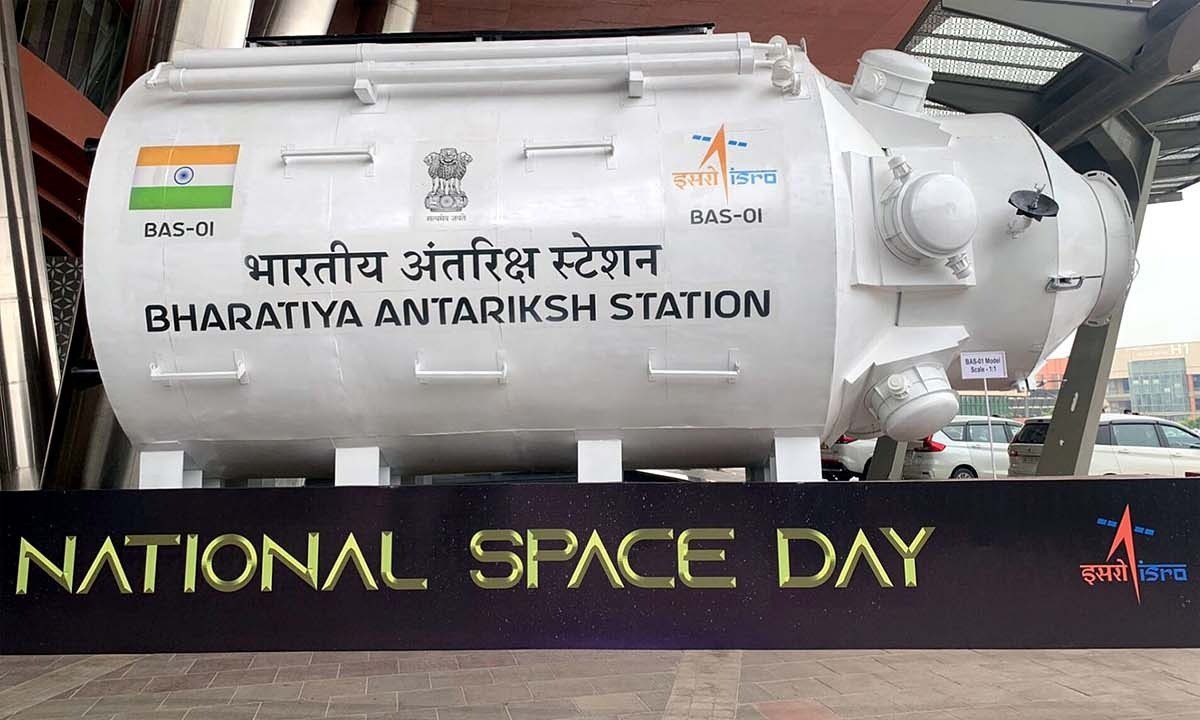
ISRO unveiled the model of Indian Space Station (BAS) on National Space Day 2025. The first module will be built in 2028 and the entire station by 2035. BAS-01 will weigh 10 tonnes. It will be 450 km above. It will promote indigenous technology, scientific research and space tourism. India will be among the few countries that run space stations.
Add informalnewz.com as a Preferred Source


The Indian Space Research Organisation (ISRO) on August 22, 2025 unveiled the model of the Indian Space Station (BAS) to the world for the first time during the two-day celebration of National Space Day. The celebrations began at Bharat Mandapam in New Delhi.
India aims to have the first module, BAS-01, in space by 2028 and the entire space station ready by 2035. This will put India in the list of select countries that run their own space stations.
What is the Indian Space Station?
The Indian Space Station (BAS) will be India’s indigenous space station, which will be established in Low Earth Orbit (LEO) 450 kilometers above the Earth. Currently there are only two space stations in the world..
International Space Station (ISS): It is run jointly by the space agencies of America, Russia, Europe, Japan and Canada.
Tiangong Space Station: It belongs to China.
India’s BAS will be different from these, because it will be completely based on indigenous technology. ISRO aims to install five modules of BAS in space by 2035, which will make it a complete space laboratory.
BAS-01 Module: First Step
BAS-01 will be the first module of the Indian Space Station, which will be launched in 2028. Its features are…
Weight: 10 tonnes
Size: 3.8 metres wide and 8 metres long
Orbit: 450 km above the Earth
Indigenous technology: It will have Bharat Docking System, Bharat Berthing Mechanism and automatic hatch system.
Environmental Control and Survival System (ECLSS): It will provide breathable air, water and temperature to the astronauts.
Viewports: Windows for taking scientific photographs and entertaining the astronauts.
Protection: Protection from radiation, heat and Micro Meteoroid Orbital Debris (MMOD).
Space Suit and Airlock: Equipment for exit into space (EVA).
Plug and Play Avionics: Modern electronics systems, which can be easily upgraded.
Objective of BAS
BAS will not be just a space station but a scientific research centre. Its main objectives are…
Microgravity research: Understanding the effects of low gravity in space, such as its effect on the human body, medicines and materials.
Life sciences and medicine: Testing technologies needed for long-term stay in space, such as supply of food, water and oxygen.
Interplanetary exploration: Developing technologies for missions like Mars and Moon.
Space tourism: BAS can be used for commercial space tourism, which will enable India to participate in space trade.
International collaboration: BAS will increase India’s participation in global space research.
Inspiration to youth: It will inspire the new generation to pursue careers in space science and technology.
Celebration of National Space Day
After the successful landing of Chandrayaan-3 on the moon on 23 August 2023, India decided to celebrate 23 August every year as National Space Day. This year this celebration is being held at Bharat Mandapam on 22-23 August 2025. During this, the 3.8 meter x 8 meter model of BAS-01 was the main attraction.
Celebrate National Space Day 2025 with us!
🗓 Aug 23, 2025
⏰ 10:00 ISTYouTube Livestreaming Link: https://t.co/RJhXb4Jll5#NSPD2025 #NationalSpaceDay 🌌
— ISRO (@isro) August 22, 2025
India’s space future
BAS is part of India’s ambitious space program. Apart from this, India has many more plans..
Gaganyaan Mission: India will send its first human mission to space by 2026.
Chandrayaan-4: Mission to bring samples from the Moon by 2028.
Shukrayaan: Mission to study Venus in 2025-26.
Space tourism: Through BAS, India will enter the space tourism market, which is estimated to be worth $13 billion by 2030.
The first module of BAS will be launched from the LVM-3 rocket, which is India’s most powerful rocket. After this, four more modules will be added, which will prepare the entire station by 2035.
Challenges and opportunities
Challenges: BAS has to be built at a high cost (about Rs 20,000 crore), technical complexity and compliance with international rules. Space debris and radiation are also big challenges.
Opportunity: BAS will make India a global leader in space research. It will promote Make in India and bring private companies, such as HAL, BEL and Tata Advanced Systems, into the space sector.

