

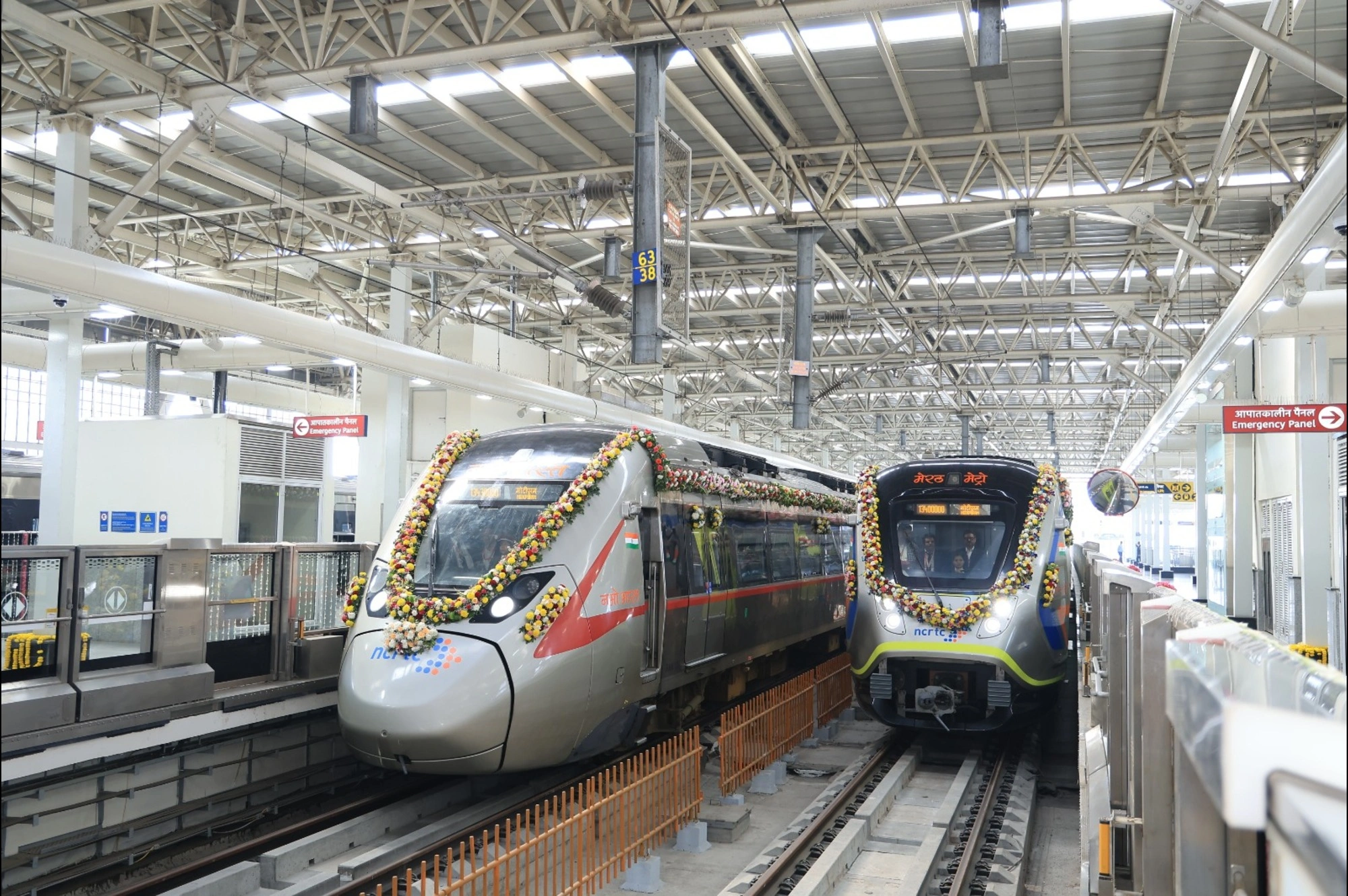
The travel time between Delhi and Karnal is about to see a major change. The Namo Bharat Corridor will reduce the journey from 3 hours to approximately 90 minutes. Between 19 and 22 stations will be built along this 136-kilometer route. This will not only reduce traffic but also accelerate development in the entire area.
Add informalnewz.com as a Preferred Source


New Delhi. Traveling from Delhi to Karnal is not an easy journey these days. Depending on traffic, bus or car travel can take anywhere from 2.5 to 4 hours, especially during peak hours. Direct and fast train connectivity isn’t always available, causing significant inconvenience to daily commuters.
This journey is about to change completely. The Haryana Cabinet has approved the construction of the 136-kilometer-long Delhi-Panipat-Karnal Regional Rapid Transit System (RRTS) corridor. The Namo Bharat Corridor, to be built under the National Capital Region Transport Corporation (NCRTC), will cover the distance from Delhi to Karnal in just 90 minutes. This means that what currently takes up to 3 hours will now be covered in one-third the time, significantly benefiting daily commuters.
What is the complete project?
This approximately 136.3-kilometer-long rapid rail corridor will begin at Sarai Kale Khan in Delhi and extend to Karnal via Sonipat and Panipat. It will be a semi-high-speed system, with trains reaching a maximum speed of 160 to 180 kilometers per hour and an average speed of over 100 kilometers per hour. This corridor is part of three major rapid rail networks in the NCR, which already include the Delhi-Meerut and Delhi-Gurugram-Bawal routes. Sarai Kale Khan is being developed as a common hub for all of these, allowing passengers to travel on different routes without changing trains.
Number of Stations and Locations
Approximately 19 to 22 stations will be built along the entire route, including five to six in Delhi and approximately 11 in Haryana. The line will pass through Kashmere Gate, Burari, Mukarba Chowk, and Narela, covering cities like Kundli, Murthal, Gannaur, Samalkha, and Panipat, and finally reach Karnal. Most of it will be elevated, while in Delhi’s congested areas it will be built underground to minimize the impact on traffic and urban infrastructure.
You can see a list of potential stations here.
Here is the complete list in a clear and understandable Hindi table:
| Serial number | Station Name | Location / Overview |
|---|---|---|
| 1 | Sarai Kale Khan | Delhi, main hub |
| 2 | Indraprastha | Delhi |
| 3 | Kashmiri Gate | Metro and ISBT integration |
| 4 | Burari Crossing | Delhi |
| 5 | Mukarba Chowk | Delhi |
| 6 | Alipur / Narela | Delhi Border Area |
| 7 | Horoscope | Haryana Entry Point |
| 8 | KMP Expressway Interchange | Highway Connectivity |
| 9 | Rajiv Gandhi Education City | Education Hub, Sonipat |
| 10 | Murthal | Food Hub Area |
| 11 | Barhi | Haryana |
| 12 | Gannaur | Haryana |
| 13 | Samalkha | Haryana |
| 14 | Panipat South | Panipat |
| 15 | Panipat North/City | Main city station |
| 16 | Panipat Depot / IOCL | Depot and Industrial Area |
| 17 | Gharaunda | extension |
| 18 | Madhuban | extension |
| 19 | Karnal | Final Terminal |
How Much Will It Cost and How Will It Be Funded?
The total cost of this mega project is estimated to be between ₹33,000 and ₹34,700 crore. The Haryana government will contribute approximately ₹7,472 crore, while the remaining amount will come from loans from the central government and international agencies. The funding model is similar to that previously adopted for the Delhi-Meerut Corridor, where a majority share is from a multilateral loan, with the remainder jointly contributed by the central and state governments.
When Will It Be Completed?
Preparations for this project have been underway for the past few years, but now it is about to gain real momentum. After receiving approval from the Haryana Cabinet on March 24, 2026, the final green light from the Union Cabinet is awaited. Construction work is expected to begin in late 2026 or early 2027, and the first section could be completed in approximately five years. This means the initial section could be operational by 2031, while the entire line is expected to be completed by 2031-32.
What will be the major benefit?
Opening this corridor will not only reduce travel time but also reduce traffic congestion on the roads. Millions of people will be able to use it daily, reducing both traffic congestion and pollution. Furthermore, new real estate, industrial, and employment opportunities will emerge in cities like Sonipat, Panipat, and Karnal. Improved connectivity will bring these cities closer to Delhi and make them attractive for investment.

