

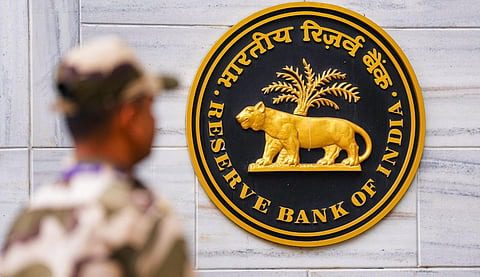
According to the RBI, Bank of Maharashtra did not provide data related to Self Help Group (SHG) members to credit information companies and did not ensure the identity of the actual beneficiary in some accounts.
Add informalnewz.com as a Preferred Source


RBI Slaps Fine On Banks: The Reserve Bank of India has imposed monetary penalties on several banks and non-banking financial companies for non-compliance with regulatory instructions. The central bank imposed a penalty of Rs 32.50 lakh on Bank of Maharashtra, Rs 29.60 lakh on DCB Bank and Rs 63.60 lakh on CSB Bank. Apart from this, a penalty of Rs 3.80 lakh has been imposed on Navi Finserv and Rs 5.30 lakh on IIFL Finance.
Several Banks Fined
According to the RBI, Bank of Maharashtra failed to provide data related to Self-Help Group (SHG) members to credit information companies and failed to identify the actual beneficiary in some accounts. CSB Bank was fined for entering into agreements with bank representatives for transactions that were outside the prescribed scope, and for failing to provide clear information to customers before charging fees on certain savings accounts.
In the case of DCB Bank, the central bank found that it did not maintain the prescribed loan-to-value (LTV) ratio for some non-agricultural gold loan accounts throughout the loan term. Meanwhile, IIFL Finance failed to correctly classify some accounts as non-performing assets (NPA) during restructuring.
Navi Finserv contacted customers at inappropriate times during loan recovery and did not follow prescribed conduct rules when sending messages. In all these cases, the RBI imposed monetary penalties for violating regulatory standards.
Lead Bank Scheme Amendment Proposal
The Reserve Bank of India (RBI) has issued a proposal for revised guidelines to make the operational structure of the Lead Bank Scheme (LBS) more effective and streamlined. The scheme was launched in 1969 with the objective of better coordinating development activities at the district level and expanding banking services in a planned manner.
Under the LBS, a Lead Bank is designated in each district to oversee financial inclusion, priority sector lending, and the implementation of government schemes. The scheme’s primary objective is to enhance credit flow to priority sectors such as agriculture, MSMEs, self-employment, and the vulnerable by establishing coordination between banks, state governments, and other development agencies. It also aims to strengthen financial inclusion and expand banking services to the last person.
The new guidelines proposed by the RBI emphasize further clarification and refinement of the scheme’s objectives. These include streamlining the structure, membership, and agenda of various forums, clearly defining the roles and responsibilities of key functionaries, and empowering the State Level Bankers’ Committee (SLBC) and Lead District Manager (LDM) offices. These changes are intended to make LBS more accountable, results-oriented, and aligned with current banking needs, ensuring better implementation of development programs at the grassroots level.
Read More: Gold Price Today: Gold and silver prices fall sharply on Valentine’s Day; check new rates

