

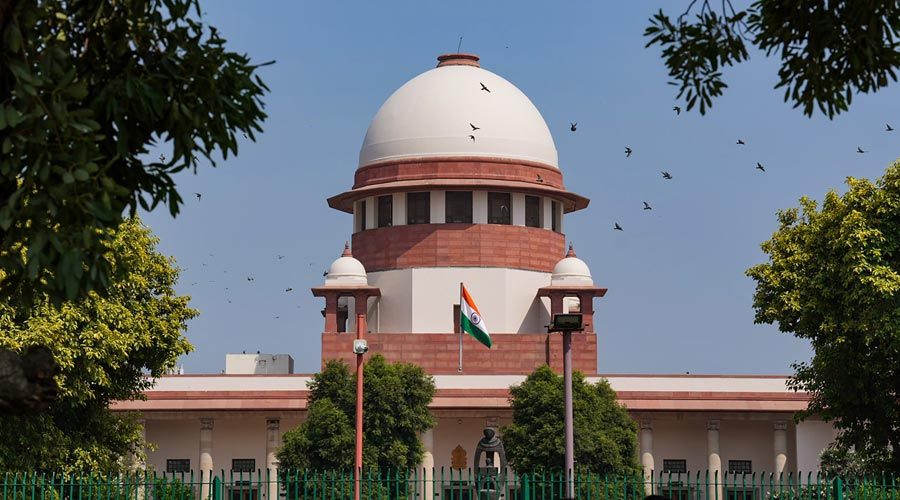
The Supreme Court stated in its order that most cheque bounce cases involve commercial disputes. Therefore, the focus should be on ensuring payment rather than punishing the accused.
Add informalnewz.com as a Preferred Source


Supreme Court on Monday (September 29, 2025) issued a significant order to expedite cheque bounce cases. The Supreme Court has established new rules for lower courts across the country. These include changes in the method of issuing summons and allowing the accused of cheque bounce to pay the amount online.
A bench of Justices Manmohan and N.V. Anjaria expressed concern that cheque bounce cases represent nearly half of the total pending trial court cases in many states. The court specifically cited Delhi, Mumbai, and Kolkata as examples. The order also provided a sample form, which provides space for filling out all the necessary information, including the cheque date, amount, and bank. The court recommended that complainants complete and attach this form to their complaint.
The order stated that most cheque bounce cases involve commercial disputes. Therefore, the emphasis should be on ensuring payment rather than punishing the accused. The court said that all the guidelines issued by it should be implemented by November 1, 2025.
What are the key guidelines given by the Supreme Court in its order?
New methods of serving summons: The complainant should provide the accused’s mobile number and email address along with an affidavit. The court should also serve summons through email, mobile number, WhatsApp, and other messaging apps, in addition to the traditional methods of delivering summons through post or police.
Personal service required: The complainant should personally deliver a copy of the summons to the accused, and then inform the court of this by filing an affidavit.
Online payment facility: Secure QR/UPI-based payment links should be made available in district courts. The summons should inform the accused that they can settle the case by depositing the amount immediately.
Summary trial should be prioritized: Courts should resolve such cases through a speedy hearing (summary trial) rather than prolonging them like ordinary civil cases. If they convert a case from summary to summons, they must record the reason for it.
Interim deposit: In appropriate cases, courts may order the deposit of an interim amount as soon as possible.
Emphasis on the presence of both parties – Personal presence of the accused and parties in court should be ensured after the service of summons. Exemptions should be granted only in exceptional circumstances.
Evening Courts – The jurisdiction of evening courts hearing cheque bounce cases should be expanded.
Dashboards – Develop dashboards for the district courts in Delhi, Mumbai, and Kolkata. These should continuously update data on the progress of cheque bounce cases. The district judges should submit reports to the High Court every three months.
Monitoring Committees – The Chief Justices of the Delhi, Bombay, and Calcutta High Courts should establish internal monitoring committees to monitor pending cheque bounce cases in the district courts under their jurisdiction and ensure their speedy resolution.
Lok Adalat and Conciliation – Cheque bounce cases should be assigned to experienced magistrates. In addition, settlement of these cases through mediation or Lok Adalat should also be encouraged.
In addition to these instructions, the Supreme Court also stated that if the accused agrees to pay the cheque amount, the court may advise both parties to compound, thus ending the case. The court stated:
If the accused pays the amount before their cross-examination, the settlement will be valid without any additional costs.
If the accused makes the payment after the defense evidence (their cross-examination) but before the verdict, they will be required to pay an additional 5%.
Up to 7.5% may be required on the payment during the hearing of an appeal/revision in the District Court or High Court, and 10% additional payment may be required if the settlement is reached in the Supreme Court.
A maximum sentence of two years is provided for cheque bouncing cases.
It is important to note that Section 138 of the Negotiable Instruments Act (NI Act) provides for a maximum sentence of two years in cheque bouncing cases. The Supreme Court has stated that those convicted in these cases are also entitled to the exemption from imprisonment under the Probation of Offenders Act, 1958. The Supreme Court has stated that if the complainant seeks additional interest or compensation in addition to the cheque amount, the court may advise the accused to plead guilty. In such a situation, the court may, using the powers of the CrPC or the BNSS, grant the accused probation while also sentencing.

